
Music AI that actually knows theory.
THIRI is the agentic harmony layer for music. Deterministic, accountable, and built to plug into the tools you already use.
Generative systems can synthesize complex sound and still fail to play a C major scale. THIRI decides the notes, the same way every time, and can show you why.
Demos
Open one and play it.
No install and no account. Open one and you are hearing the engine in about ten seconds.
KORUS
Sing one line and hear it answered in five parts, in your own voice, with your formants intact. It voices against the chart, so the harmony moves when the chord does. A browser and a microphone, nothing to install.
Open KORUS →The live host still serves the old landing page until thiri-demo-web #3 merges.
Helix Arpeggiator
Voice-led paths across your changes. Every note is legal against the chord underneath, and every performance is reproducible from a seed and a tempo, so you can keep the take you liked.
Open Helix →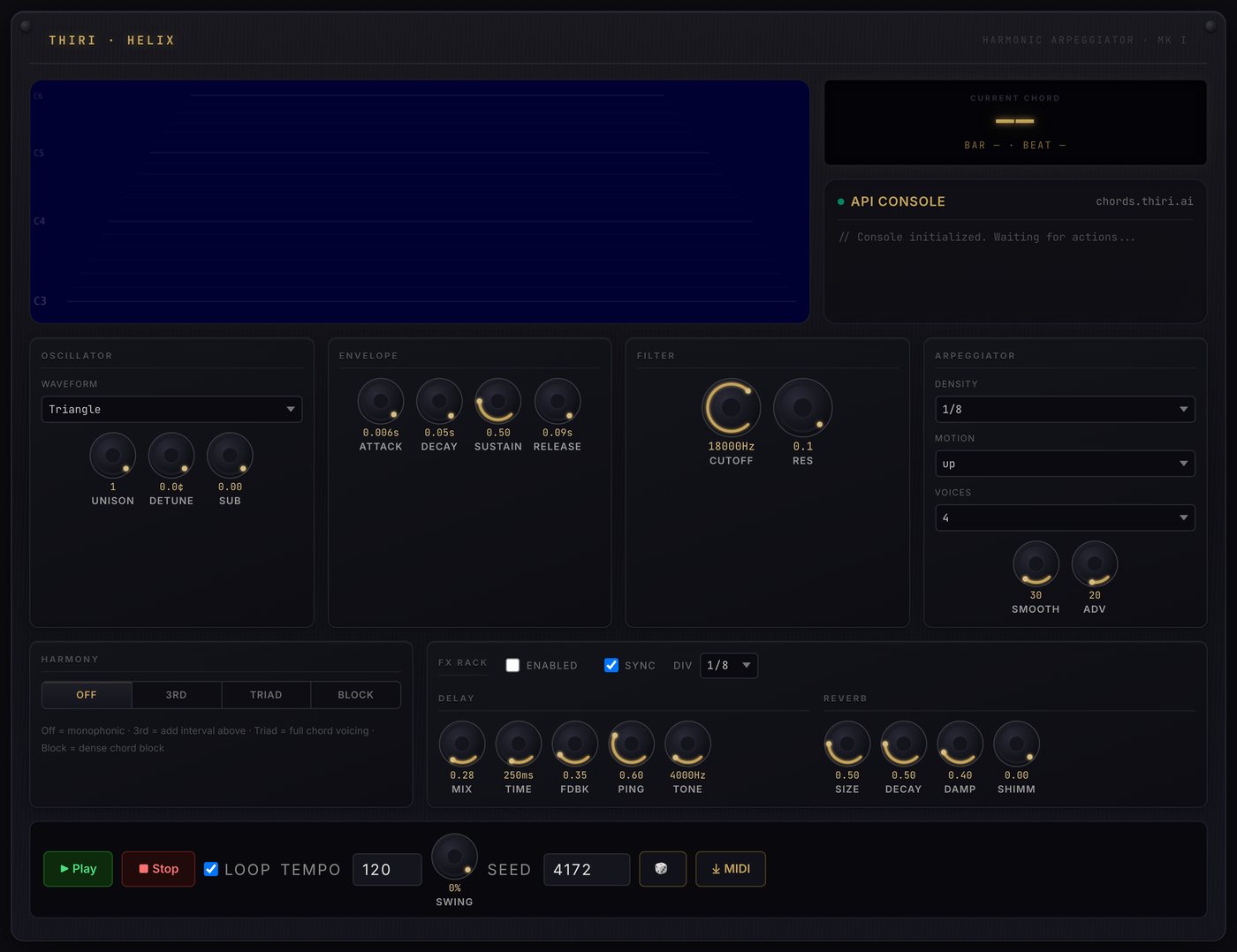
Conductor
Describe the feel in words. THIRI arranges a four-piece band with harmony, bass and drums, then plays it in the browser. The theory is decided before a note is rendered.
Open Conductor →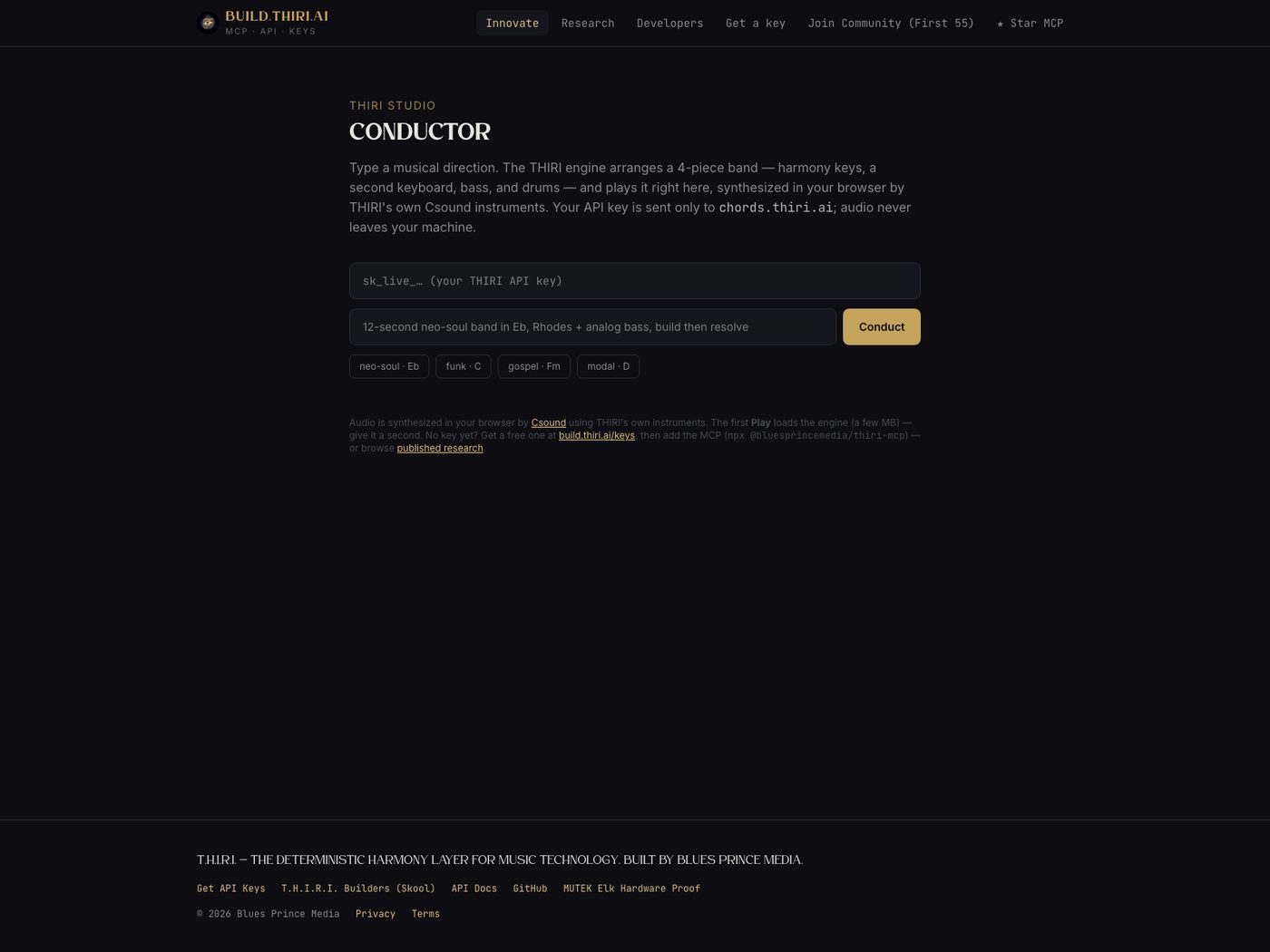
Studio Rack
Helix, Vocal, Keys, Drums and Band in one page, each wired to the live API. The closest thing to seeing the whole engine at once.
Open Studio Rack →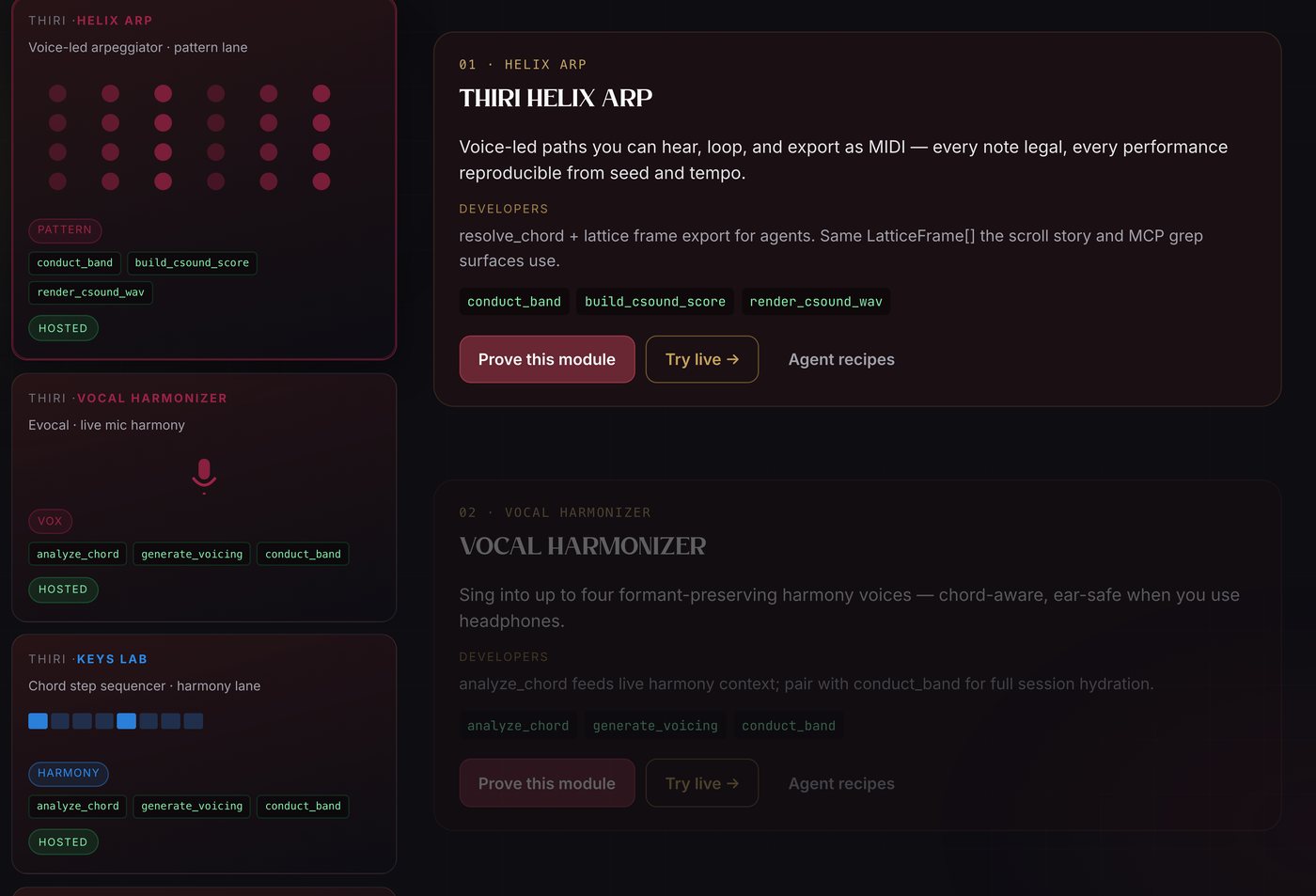
Sound Corpus 3D
155 sound samples mapped across Pitch (X), Timbre (Y), and Envelope (Z) in Euclidean space. Grounded by THIRI's deterministic theory engine so an AI agent can query sound with mathematical certainty.
Open Corpus 3D →Live 3D Web Audio Canvas
In development
THIRI on an instrument, and on a stage.
HRN SXTN is the harmony engine pointed at a single horn. Play one line and hear a section in your own tone. It is a build in progress, not a product, and everything measured about it is published.
Three parts, one instrument.
THIRI decides the notes. It never synthesises: each harmony voice is your own sound moved onto its calculated note, formants kept, so the section is still you.
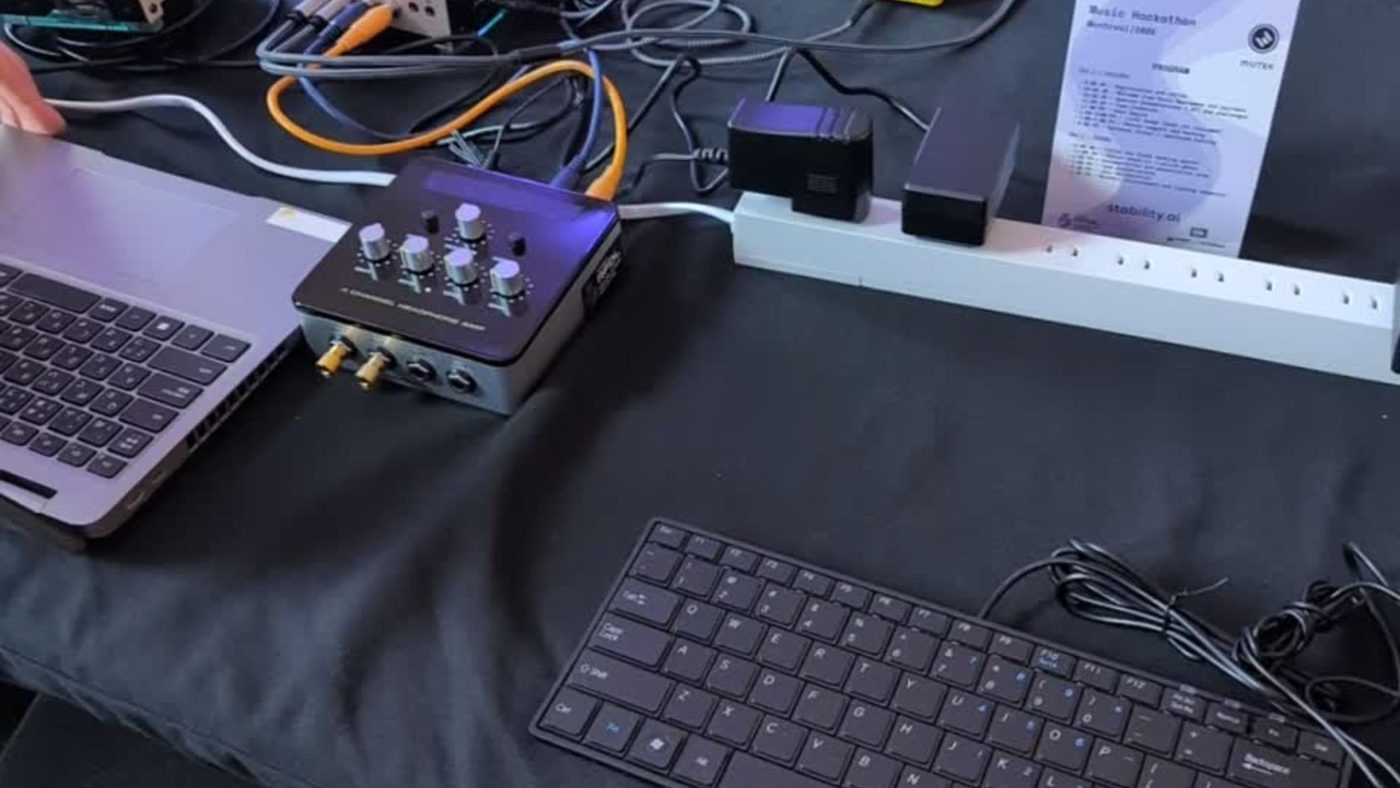
Elk Audio supplies the hardware. Their Stomp runs a headless audio OS, which is what lets the whole engine sit inside a 1.333 ms callback with no computer in the room.
MUTEK and Music Hackspace are where it was built and judged. Two days in Montreal, August 2026: first in the Elk Audio challenge, second in Roland Project LYDIA.
The VST and the standalone
A plugin for your DAW and an app that runs on its own. Five voices of formant-preserving harmony off a live horn, voiced against the chart rather than a fixed interval. This is the build that won the challenge, running in Ableton.
See the desktop line →No screenshot of the VST or the standalone exists yet, and a board photo here would read as the pedal.
The stomp pedal
The same engine, headless on a stock $399 Elk Stomp. No laptop, no network, no second box. Five voices at 0.82 ms average and 1.11 ms worst against a 1.333 ms deadline, zero dropouts across three sweeps.
The pedal is a measurement instrument first. You cannot buy it. What it has not had is players: everything measured so far was measured by the person who built it, on one board, with one horn.
See the pedal →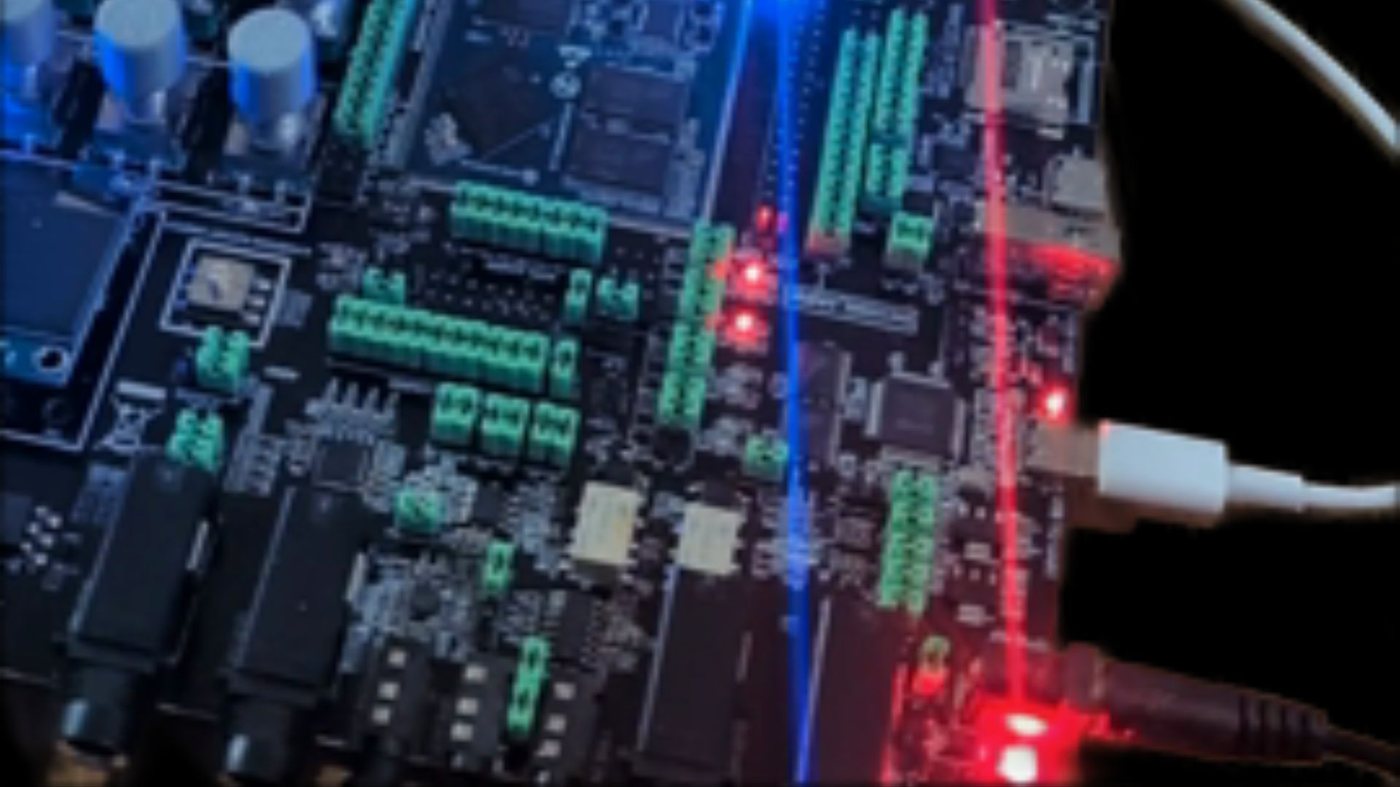
Products
Things you can buy.
The engine in a tool you keep, rather than a page you visit.
Composer C
Sketch a progression, reharmonise it, hear it voiced properly, and keep the result, because it will be the same result tomorrow. Form, harmony, layers and stems from one spec you can carry on editing.
Open Composer C →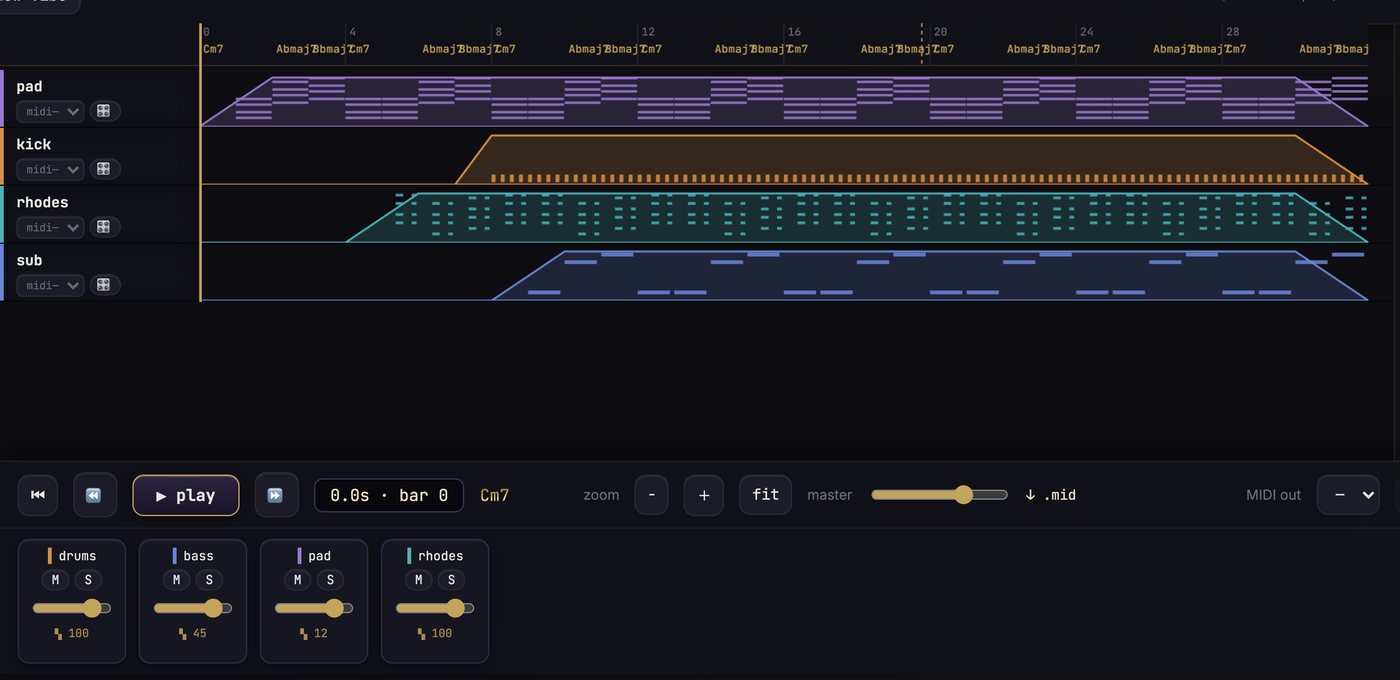
Run the Changes
A practice tool that holds you to the chart. It generates the changes, voices them correctly, and keeps the harmony honest while you play over it, so what you hear in the room is what the tune actually does.
Play Run the Changes →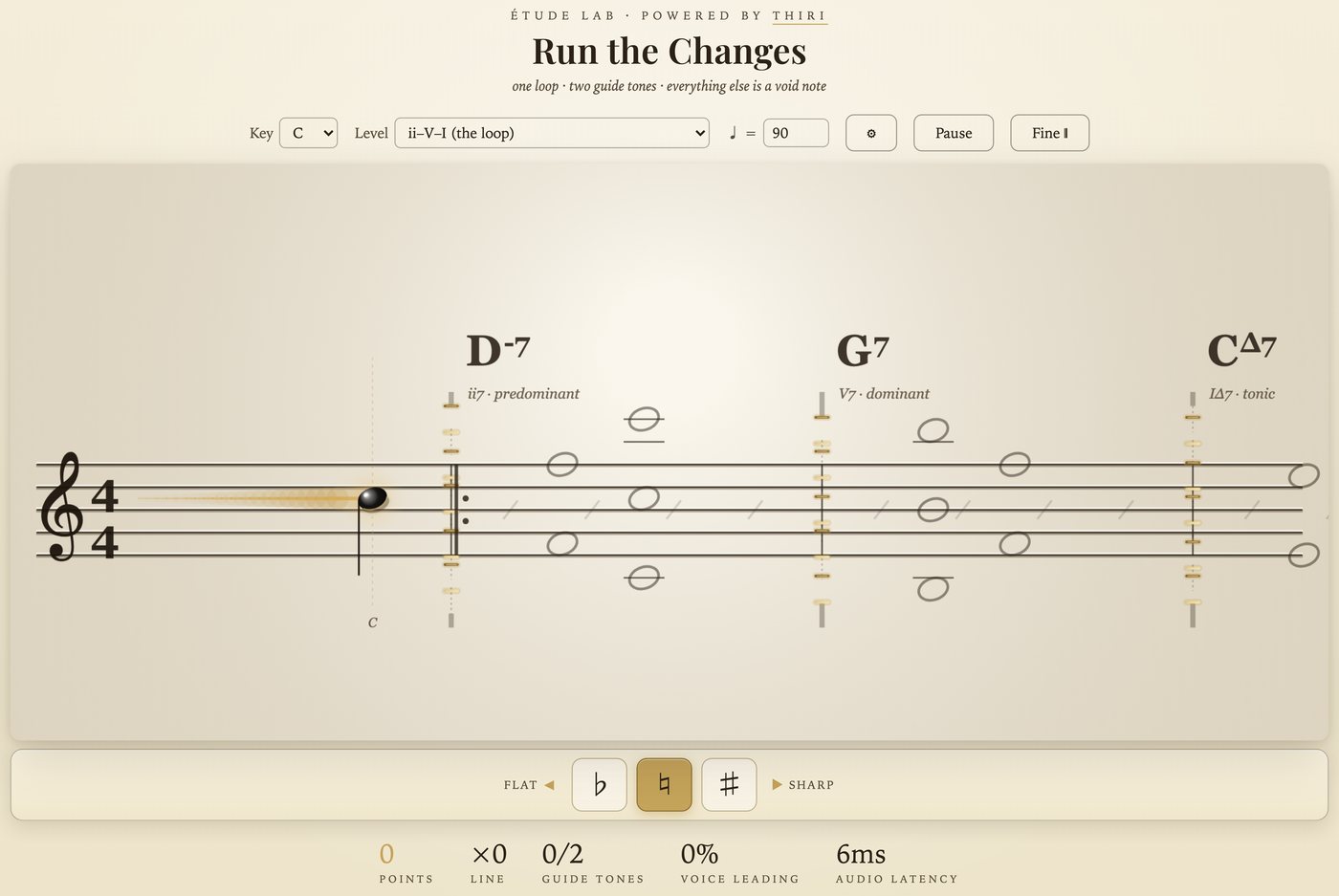
FYLLM
Drop in an AI video and get a score that follows the cut, rendered on your own Mac with the same harmony engine underneath. Nothing leaves your machine. Licences from $47.
Get FYLLM →Developers
A ground truth rail your agent can call.
The same engine behind every demo above, over MCP and REST. Ask for a voicing and you get the same answer every time, with the reasoning attached.
THIRI MCP server
Chord analysis, resolution, voicing, reharmonisation and band arrangement as tools an agent can call directly.
Read the MCP docs → Claude connectorConnect it to Claude
Add THIRI as a connector and let Claude reach for real harmony instead of guessing at one.
Set up the connector → Hosted APIbuild.thiri.ai
The developer surface: docs, keys, and the instrument playground the demos are built on.
Open build.thiri.ai → Try a callchords.thiri.ai
The chord endpoint on its own, for a first request before you wire anything up.
Open chords.thiri.ai →Audition the five MCP tools live in your browser
Try voicings, scale analysis, reharmonizations and groove arrangements with real-time geometric visualizers.
Research
We publish the numbers, including the ones that did not work.
Harmonic integrity is a claim, so it gets evidence. Every figure below has a page behind it with the method and the raw data.
| Measurement | Result | Against |
|---|---|---|
| Average block | 0.82 ms | 1.333 ms deadline |
| Worst block | 1.11 ms | 1.333 ms deadline |
| Dropouts | Zero xruns | Across three sweeps |
| Voices | 5 | Headless JUCE 8 VST3 under Sushi 1.3.0 |
HORN SXTN on an Elk Stomp
The full profiling teardown behind the table above, first place in the Elk Audio challenge at MUTEK Montreal.
Read the deep dive → Negative resultText prompts do not hold harmony
Why audio conditioned diffusion does not give you symbolic control, written up with what we tried.
Read the finding → IntegrationRoland Aerophone, audio and MIDI
Notes and breath over MIDI, envelope and timbre over line audio, and what that split buys a wind player.
Read the dossier → LandscapeConnection is not yet intelligence
A look at Roland Cloud and where connected instruments stop short of musical decisions.
Read the note → LandscapeAn agent in the session still needs a theory layer
What happens when an agent gets a seat in the DAW without a rail to hold it.
Read the note → EverythingAll research
The full archive, plus findings on MuseScore notation and the Game THIRI notes.
Open the archive →Community
Builders who want the theory to hold.
T.H.I.R.I. Builders is the group for people wiring this into their own work. Free to join, with weekly builder calls.
- Weekly builder calls.
- Repos and examples built on the engine.
- The place to ask when a voicing is not doing what you expect.
Game THIRI
We write when there is a verified benchmark, an architectural break, or a real shift in music technology. Nothing auto sends.
About
Built by Dennison Blackett.
A saxophone player building the harmony layer he wanted to play through. THIRI is developed at Blues Prince Media in Montreal.
- 1st place, Elk Audio challenge, Music Hackspace and MUTEK hackathon, Montreal.
- 2nd place, Roland Project LYDIA challenge, same event.
Container is ready at 16:9.